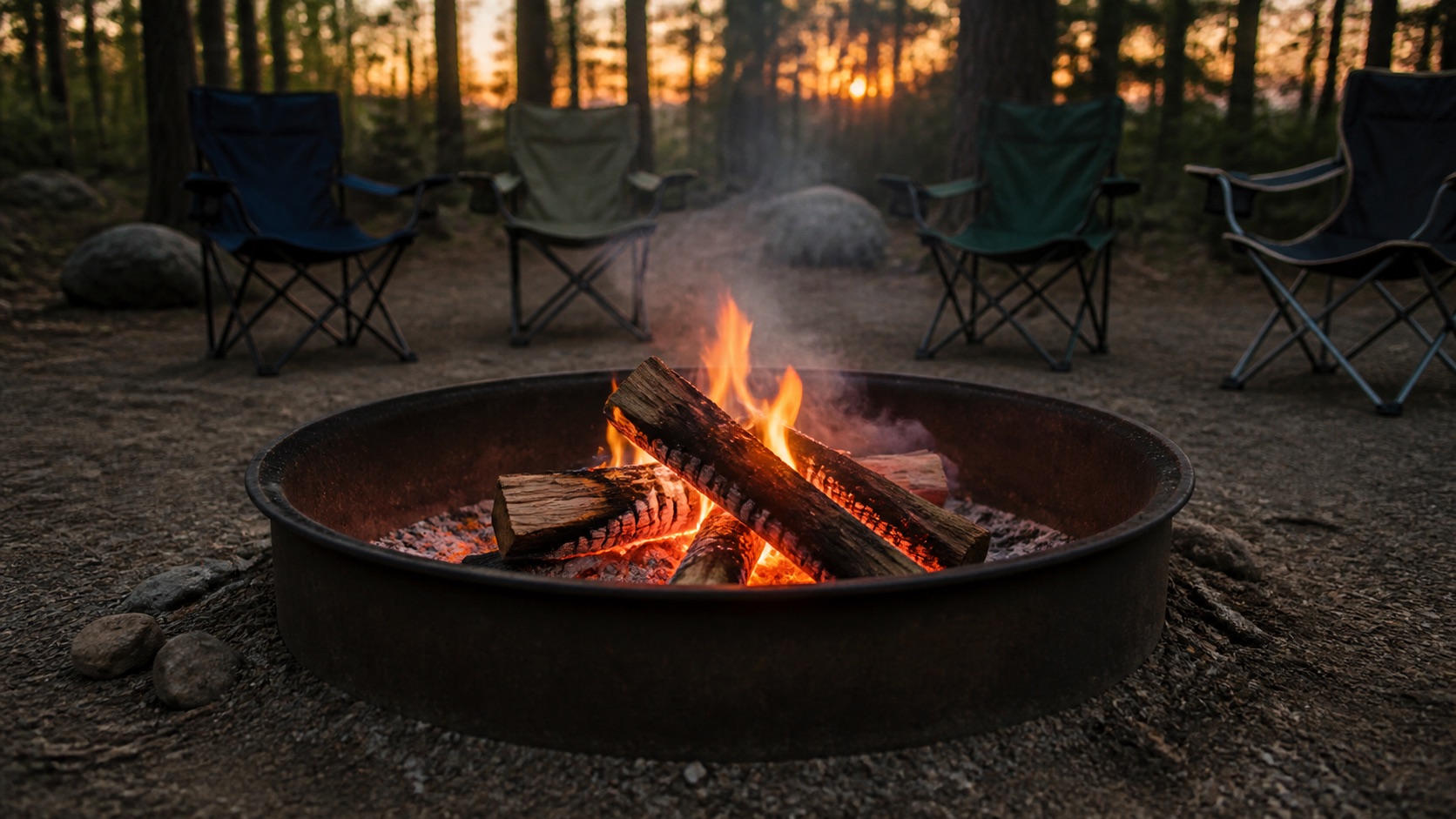
Camp Stove vs Open Fire Cooking: Fire Ban Compliance, Heat Control & Fuel Runtime
Determine exact legal compliance under Stage 1 & Stage 2 campfire bans, calculate propane and isobutane fuel runtimes, and master simmer control and soot prevention with our interactive field engine.
Under USFS and state park Stage 1 and Stage 2 fire restrictions, portable camp stoves fueled by pressurized gas (propane, butane, isobutane) or liquid petroleum equipped with an on/off shut-off valve are permitted, while open wood campfires and charcoal are strictly banned. A standard 16.4 oz green propane cylinder powers a dual-burner stove on medium for approximately 2.0 to 2.2 hours (enough for 6 hot cooked meals), whereas an 8 oz isobutane backpacking canister provides roughly 130 minutes of medium simmering.
Key Field Takeaways
1Fire Ban Rule: Stoves with an operable on/off shut-off valve (propane, isobutane, white gas) are permitted in Stage 1 & Stage 2 fire bans. Solid wood, charcoal, alcohol stoves, and bio-twig stoves are strictly prohibited.
2California Mandate: On all California public lands (USFS, BLM, State Parks), an official California Campfire Permit (free online) is legally required even for gas camp stoves.
3Propane Runtime: A standard 16.4 oz (1 lb) green cylinder delivers ~21,500 BTUs—roughly 2 hours of dual-burner medium cooking or 1 hour on continuous high.
4Isobutane Runtime: An 8 oz (230g) backpacking canister provides ~11,000 BTUs—approx 130 minutes of medium flame or 12 to 14 liters of boiled water.
5Soot Prevention: Smear a thin layer of liquid dish soap on pan bottoms before open-fire cooking. Black carbon washes off instantly under water without scouring.
6Cold Weather Limit: Canister isobutane drops pressure below 20°F (-7°C). Propane (liquid boils at -44°F) or inverted liquid-feed stoves are mandatory for sub-freezing camping.
Camp Stove vs Open Fire: Fire Ban Triage & Fuel Estimator
Determine exact legal compliance under Stage 1 & Stage 2 campfire bans, estimate propane/isobutane canister runtimes, and compare heat control physics.
Stage 2: Total Open Fire BanOfficial USFS / BLM Standard
High fire danger conditions. All open campfires, charcoal grills, wood-burning bio-stoves, and fire pits are strictly prohibited across both developed campgrounds and dispersed recreation areas. Only portable stoves fueled by pressurized gas or petroleum with an operable shut-off valve are permitted.
Mandatory Field Requirements:
•Total prohibition on wood campfires and charcoal briquettes everywhere on public lands.
•Appliance MUST operate on pressurized gas (propane, butane, isobutane) or liquid petroleum with an on/off shut-off valve.
•Alcohol stoves (penny/soda can), Esbit solid fuel tablets, and twig-burning stoves are STRICTLY ILLEGAL.
•Stoves must be operated within a barren clearing of at least 3 feet diameter.
Appliance Status Under Stage 2
Rule Criteria: Operable On/Off Shutoff Valve
Dual-Burner Propane Stove (Coleman / Camp Chef)
Meets USFS / BLM shutoff valve requirements. Permitted in Stage 1 and Stage 2 bans.
Threaded needle shut-off valve complies with fire ban standards.
ALLOWED
Pressurized Liquid Fuel Stove (MSR WhisperLite)
Permitted if pump valve can immediately shut off pressurized fuel flow.
ALLOWED
Open Wood Campfire (Fire Pit / Fire Ring)
Banned in Stage 1 dispersed areas and Stage 2 everywhere. Generates airborne sparks.
PROHIBITED
Charcoal Briquettes (Dutch Oven / Portable Grill)
Classified as solid fuel. Cannot be instantly extinguished; banned in Stage 2.
PROHIBITED
Alcohol Stove / Esbit Solid Tablets / Twig Stove
STRICTLY PROHIBITED during fire bans. Lack of shut-off valve makes them illegal under Stage 1 & 2.
PROHIBITED
Important Legal Disclaimer & California Requirement: Always verify local conditions with your destination’s local Ranger District or County Fire Marshal before lighting. Specific emergency fire closures supersede general stage guidelines. On all California public lands (USFS, BLM, State Parks), an official (free) California Campfire Permit is legally required to operate portable gas stoves.
01.Open Fire Ban: Is That a Camp Stove? Legal Definitions by Stage
When forest services enact fire restrictions, understanding the exact legal dividing line between an "open fire" and an "approved stove" prevents hefty fines and wildfire danger. The primary legal criterion is the presence of an operable on/off shut-off valve that instantly stops fuel flow. The matrix below outlines legal permissions across standard USFS/BLM restriction stages:
Open Fire Ban: Is That a Camp Stove? Legal Definitions by Stage reference table
Restriction Level
Wood Campfire
Charcoal Briquettes
Pressurized Gas / Propane
Alcohol / Bio-Twig Stove
Stage 0 (No Bans)
Allowed in fire rings
Allowed in grills/pits
Allowed everywhere
Allowed with 10ft clearing
Stage 1 (Restrictions)
Developed steel rings only; BANNED in dispersed
Developed fee sites only
Allowed everywhere with shutoff valve
PROHIBITED in dispersed areas
Stage 2 (Total Fire Ban)
STRICTLY PROHIBITED everywhere
STRICTLY PROHIBITED everywhere
ALLOWED if equipped with on/off shutoff valve
STRICTLY PROHIBITED everywhere
Red Flag Warning
STRICTLY PROHIBITED everywhere
STRICTLY PROHIBITED everywhere
Restricted to 3-ft bare mineral clearing
STRICTLY PROHIBITED everywhere
02.Propane & Isobutane Canister Runtimes: How Much Fuel to Pack?
Running out of fuel on night two is a classic camping error. A standard 16.4 oz green propane bottle contains ~21,500 BTUs of energy. Operating a typical 10,000 BTU burner on medium consumes approximately 5,000 to 6,000 BTUs per hour, yielding roughly 2 to 2.2 hours of total burn time per cylinder. For a weekend trip (2 people, 3 days, 2 hot meals per day), pack 2 green cylinders. For ultralight backpacking with an 8 oz isobutane canister, budget 12 to 15 grams of fuel per 500ml boil; one 230g canister covers up to 14 boiled meals.
03.Simmer Precision vs Radiant Wood Heat: The Culinary Physics
Camp stoves excel at convective, localized heat that can be throttled to a bare simmer—critical for scrambled eggs, oatmeal, and delicate sauces that scorch above 220°F. Conversely, deep beds of hardwood embers emit broad-spectrum infrared radiant heat exceeding 800°F (425°C). Radiant heat penetrates thick cuts of meat and cast iron evenly, creating deep Maillard browning and steak crusts that standard 10,000 BTU gas burners struggle to replicate without dropping temperature.
Wood fires deposit sticky vaporized wood tar (creosote) and carbon soot across the exterior bottoms and sides of cookware. Before placing stainless steel pots or cast iron skillets over open fire grates, rub a thin layer of liquid dish soap (Dawn or biodegradable camp soap) across the entire outer bottom and lower sides, letting it dry to a slight tack. During cooking, soot adheres to the soap film rather than bare metal. At cleanup, a splash of water dissolves the soap barrier and rinses the soot away effortlessly.
Crosswinds of just 10 mph can steal up to 50% of an open flame’s heat output. Always position 2-burner stoves with their side windshields locked in place. For canister stoves, never wrap an aftermarket aluminum windscreen tightly around the gas cylinder; radiant heat trapped against the canister wall risks catastrophic over-pressurization. Maintain a minimum 1-inch ventilation gap around the canister base.